Debatable Communication Credential

Prove you can think on your feet.

AI can write your essays and your resume. Nobody can outsource a live conversation.

Make a complex case out loud, in real time, under interruption. You get a Communication Score, a worldwide percentile, and a five-dimension profile. Free, verifiable in one click.
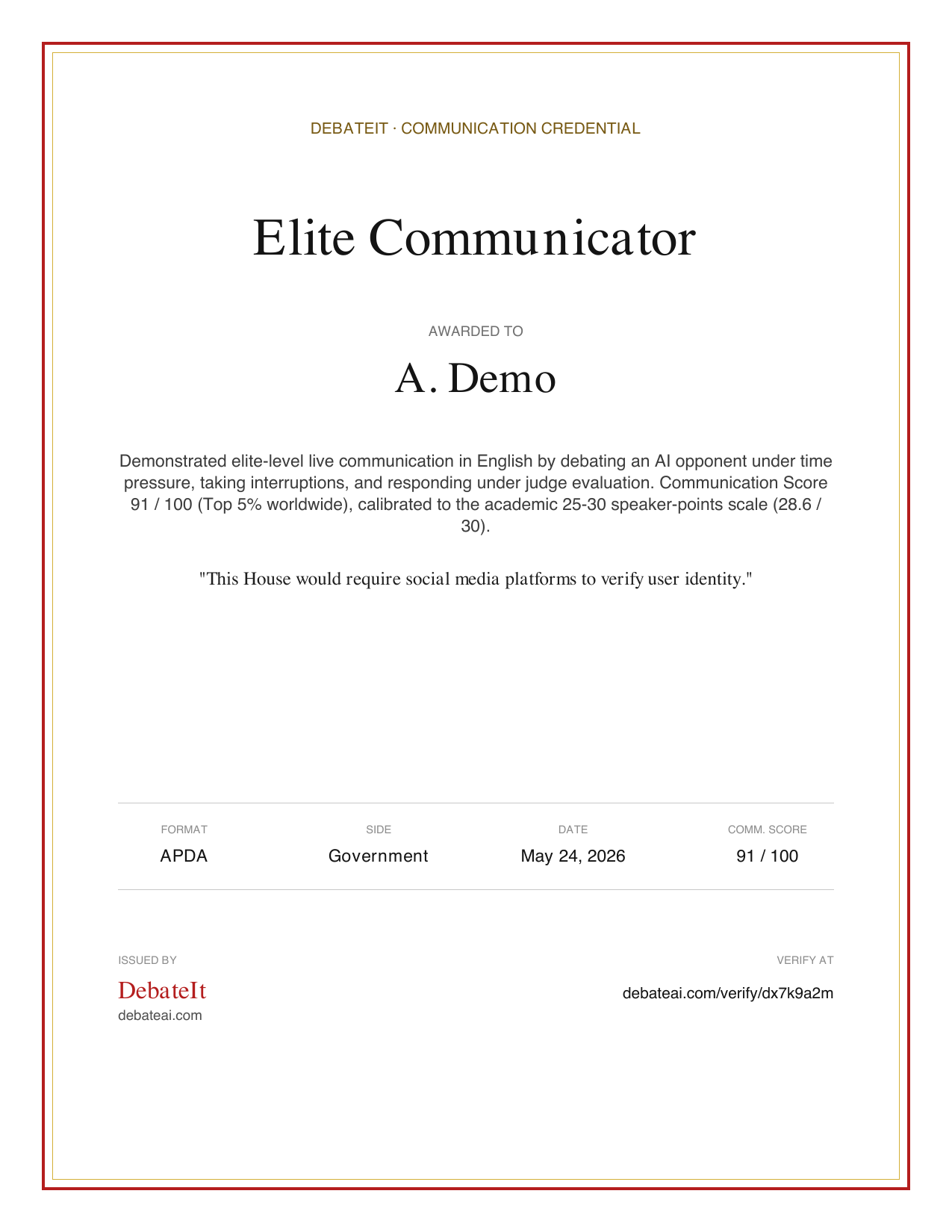
Communication Score Verified
91/ 100
Top 5% worldwide Elite Communicator 28.6 / 30 speaker scale
Reasoning94
Listening89
Persuasion92
Clarity90
Responsiveness88
Sample profile. Score out of 100, percentile worldwide.
In short

You argue out loud for five to eight minutes. Something argues back.

A judge scores five things about how you handled it and issues a score out of 100, a worldwide percentile, and a one-page certificate with a link anyone can check. It is free, it takes about ten minutes, and you can retake it. Everything below is the detail.

The credential

Earned live. Checked at a URL.

The certificate at the top of the page is the artifact: one page, with a verify URL that catches a forged copy in two clicks. This is where it comes from.
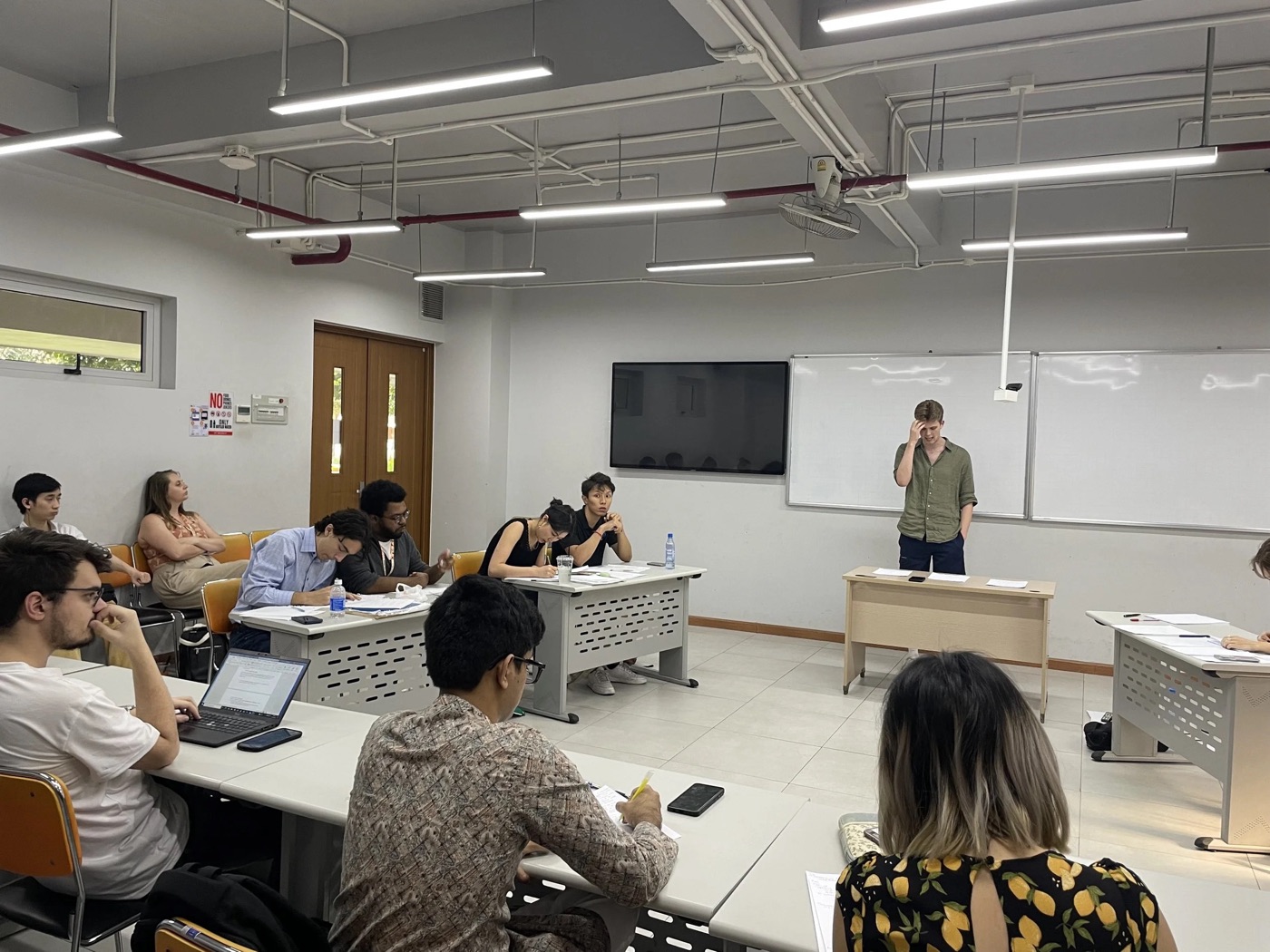
A debater on their feet mid-speech while both benches and the judges follow the argument.
A live round. The eight minutes the score comes from.
Why this matters now

The value of written credentials is falling. The value of live communication is rising.

Anything you can prepare in advance, a model can help you produce. It cannot sit in the chair for you when someone pushes back in real time.

AI assisted
  • Essays
  • Resumes
  • Cover letters
  • Take-home assignments

Polished in advance, with help. The reader can no longer tell how much was you.

Human verified
  • Interviews
  • Negotiations
  • Presentations
  • Debates
  • Sales conversations

Live, unscripted, no second draft. This is what the credential measures.

For college applicants

For college applications, when the essay no longer proves it was you.

Every application reads polished now, and admissions officers have no way to check who wrote what. A live score someone else can verify is a different kind of evidence. No college requires or endorses this; you choose to attach it, the way you attach a portfolio link.

Where it goes

On the application itself

The Common App Additional Information section takes a link, and the activities list has room to name an assessment and its score. So do scholarship forms, honors college supplements, and a personal site. Paste the verify URL and a reader checks it in one click, with no login and no email to the issuer.

What it adds

Evidence nothing else in the file carries

A recommendation letter is someone else's opinion of you. An essay is authorship nobody can confirm. This is a score, a worldwide percentile, and a transcript of you holding an argument while being interrupted. It is the one line in the file a stranger can independently check.

The side benefit

It is also interview practice

Alumni interviews, scholarship panels, and honors college interviews are all live, unscripted, and timed. The assessment is that same shape: think, get pushed, respond without a script. Practice the thing you are about to be judged on, then submit the score if you like it.

No credential decides an admissions outcome, and anyone who tells you otherwise is selling something. What this gives you is the one line in the file a reader does not have to take on trust.

The evaluation system

Five dimensions of live communication.

Every assessment produces a five-axis profile, not a single grade.

01
Clarity
Pacing, filler-word density, intelligibility, structural signposting. Are you understandable under time pressure?
Not measured: accent. Indian, Nigerian, Filipino, Brazilian English all valid.
02
Reasoning
Warrants, internal links, evidence usage where the format calls for it, ability to weigh competing impacts.
Not measured: name-dropping. Citing Rawls is not reasoning.
03
Responsiveness
Direct rebuttal vs. ships-passing non-engagement. Willingness to concede where appropriate and reroute when an argument lands.
Not measured: aggression. Calm reframing beats interruption.
04
Listening
Cross-examination response quality, accurate paraphrasing of opponent claims, on-topic answers to follow-up questions, willingness to clarify.
Not measured: silence. Long pauses are not listening.
05
Persuasion
Rhetorical structure, conclusion strength, late-speech crystallization, register-matching to the format you picked.
Not measured: volume. Loud is not persuasive.

The composite is a weighted blend of the five sub-scores, mapped onto the academic 25-30 speaker-points scale. The sub-scores are visible on your personal dashboard alongside a sparkline of how each axis is trending across rounds.

How it works

Three steps. About ten minutes.

Step 01

Pick a motion, pick a side

APDA, BP, WSDC, Policy, LD, PF, Congress, MUN, or impromptu Quick Clash. The format you pick determines the round shape and the register the AI uses.

Step 02

Argue out loud

Live voice, real time pressure. The AI takes points of information, interrupts, and pushes back. You speak for the time the format demands.

Step 03

Get your score

An AI judge writes a ballot and turns it into your Communication Score and percentile. Clear the median and you earn a shareable credential at a public verify URL. Below it, you still keep your score and profile to train from.

The detail

Open what's relevant to you.

Eight boxes. The scoring ladder, the eight-beat format, how it sits next to IELTS and TOEFL, and what a university or employer sees when they open your verify link.

The assessment, end to end

Eight beats. Five to eight minutes of you talking.

8 beats·90-second opening·no notes
OpenClose

A structured live exam, not an open-ended chat. Fixed timing, fixed weighting, identical for everyone. This is the flow the certificate is calibrated against.

01
AI interviewer introduces the motion. Specific, contemporary, non-trivial. Not "AI is good or bad." A real motion at the level of a real tournament round.
~30s
02
You give your opening response. Time-pressured. No notes. Lay out your case and your top two warrants.
90s
03
AI pushes back on the strongest line. Specific objection, not a generic counter. Tests whether your case can survive contact.
~45s
04
You clarify or adapt. The hard move: hold structure under correction without folding, and concede where the concession is real.
60s
05
AI opens a second disagreement front. Forces register-switching. Now you are arguing two things at once.
~30s
06
You summarize the opponent's case before responding. The single hardest move in debate. Tests listening, not arguing.
30s
07
You respond under time pressure. The synthesis. Weigh both fronts, crystallize, land on a takeaway a judge can write down.
90s
08
Reflective close. AI asks one off-the-flow question. Tests calm reasoning when the clock is no longer the threat.
30s

The casual voice round (any motion, any length, no fixed structure) stays available for practice. Only the structured eight-step assessment above produces a credential you can hand a school or an employer.

The five levels

One ladder, from your first round to the top 1%.

5 levels·credential clears at 75·Top 1% at 94+
OpenClose

Finish a round, get a score and a worldwide percentile. Clear the median and the credential is shareable at one of four levels.

Emerging Communicator
You finished a live round under pressure. Your score is your starting line. Keep training to clear the credential bar.
Score under 75
Entry · keep training
Effective Communicator
Holds a five-minute case and answers pushback without folding. Your first earned, shareable credential.
Top 50%
Score 75-81
Advanced Communicator
Holds structure through correction. Above the median speaker in a varsity room.
Top 20%
Score 82-87
Elite Communicator
Moves an audience, not just wins the point. Clearing speed at a real tournament.
Top 5%
Score 88-93
Exceptional Communicator
Final-round caliber. Leadership-grade live communication. Genuinely rare.
Top 1%
Score 94+

Levels are calibrated to the academic 25-30 speaker-points scale that university tournaments grade on: the median varsity speaker (27.0) sits at the Effective bar, and a final-round speech (29.0+) maps to Exceptional. The score you see is that judged result, rescaled to the 0-100 Communication Score. Percentile bands are descriptive guidance, not a psychometric mapping, and not a substitute for IELTS / TOEFL / Cambridge where a program specifically requires those tests.

Assessment pathways

Different rooms, one profile.

1 live·4 on the way
OpenClose

The live debate round is the assessment available today. More pathways are on the way, each a different kind of live pressure: a hiring interview, a stakeholder conflict, a sales objection.

01Live now
AI debate assessment
A judged voice round against an adversarial AI across a dozen formats. Fast, accessible, sittable from any laptop with a microphone.
Get your score →
02Beta
Human debate assessment
Spar a real opponent instead of the AI. A tougher, higher-credibility round. Live human sparring is open now; scored credentials from human rounds are rolling out next.
Spar a human →
03Coming
Interview assessment
An AI interviewer. Tell me about yourself, explain a disagreement, defend a decision, respond to criticism. The closest pathway to hiring.
On the roadmap
04Coming
Leadership assessment
Team conflict, stakeholder persuasion, strategic communication under ambiguity. For managers and founders, not just speakers.
On the roadmap
05Coming
Sales assessment
Handle the objection, hold the frame, move to close. A live pitch against an AI buyer who is not an easy sell.
On the roadmap
+One profile
It all rolls into one score
Every pathway feeds one score, one percentile, one verifiable profile.
See the profile →
Global access

Built for who tests lock out.

6 regions·14 languages
OpenClose

A student in Lagos, Delhi, São Paulo, Nairobi, or Jakarta should be able to prove they can argue complex ideas in English under pressure. No $215 test-center sitting, no flight to a regional capital, no elite-school transcript required.

DELHI · MUMBAI · BENGALURU

For Indian students applying out of CBSE / ICSE / IB schools

A spoken-English signal that complements IELTS / TOEFL submissions and stands on its own in Indian-circuit university applications. Format-aware: Asian Parli, WSDC, and Frank Anthony register are scored on their own merits, not flattened to American norms.

LAGOS · NAIROBI · ACCRA

For African applicants targeting global universities or remote roles

A free credential that proves live English competency without sitting an IELTS in Lagos at a price most applicants can't justify. The verify URL is anywhere with a browser; the credential is anywhere with a verify URL.

JAKARTA · MANILA · HO CHI MINH

For SE Asian remote workers in global hiring pools

If your work involves arguing live in English (customer-facing roles, consulting, sales, support), your resume currently has no way to prove that. The communication profile does.

SÃO PAULO · BOGOTÁ · MEXICO CITY

For Latin American applicants to English-medium programs

Pairs with TOEFL / Duolingo English Test as a parallel signal. The eight-step structured assessment is sittable from any laptop with a microphone. No Pearson Vue appointment required.

KYIV · ISTANBUL · CAIRO

For applicants from contexts where elite institutional access is limited

A portable credential that travels across borders, visa systems, and admissions cycles. Not tied to a school you attended or a country you took a test in. Tied to a five-minute live round you can defend.

EVERYWHERE

For founders, consultants, lawyers, and policy students

If oral argument is the job (pitching investors, defending a client, briefing a stakeholder), the credential proves you can do it under live pressure. Distinct from anything written on your resume.

Debatable runs in 14 spoken languages (Hindi, Spanish, French, Portuguese, Arabic, Mandarin and more), though the certificate program is currently English-first. Localized assessments, native-language sub-tracks, and cross-language voice-converted debates are on the roadmap so two speakers from different backgrounds can still clash in one room.

Comparison

Next to IELTS and TOEFL.

Free·versus $59-$330
OpenClose
Credential
Format
Cost
Verification
IELTS Speaking
Interview + monologue, 11-14 min
~$215–$260
Paid verification request
TOEFL Speaking
Four recorded tasks, ~17 min
~$185–$330
MyBest Scores + score report
Cambridge B2/C1/C2
Classroom + interview, ~3-4 hr total
~$165–$280
Cambridge Results Verification Service
Duolingo English Test
Adaptive grammar + read-aloud + short answer, ~1 hr
~$59
Duolingo verification, 2-day issue
Coursera / edX certificate
Multiple-choice quizzes + async assignment
~$39–$99 per certificate
Public certificate URL
Debatable Certificate
Judged live voice round, ~5-12 min, adversarial
Free
Public verify URL · no contact required

Debatable Certificates measure adversarial spoken English under live time pressure, the one signal that AI cannot trivially generate. That's a different skill than the structured monologue and interview formats above. We don't compete with IELTS / TOEFL / Cambridge where a program requires those exams; we offer a parallel signal that's free, faster, real-time, and tests something they don't.

Your communication profile

The certificate is the trophy. The profile is the product.

5 dimensions·one public page·score over time
OpenClose

A page you come back to, not a PDF you file away.

Every assessment writes to one public profile: your Communication Score, your percentile, and a five-dimension radar showing where you're sharp and where to drill.

Round history sits below the radar: every assessment with date, format, motion, score, and its own verify URL. The score is a number you can train; the profile is where you watch it move.

Open your profile →
Score over time +13 since March
Mar 78Apr 82May 86Jun 91

Sample profile · Elite Communicator · Top 5% · Strengths: reasoning, persuasion · Drill: responsiveness under interruption

For employers and universities

A recruiter understands the candidate in thirty seconds.

No login·public verify URL·ballot + transcript
OpenClose

Every credential lives at a public, no-contact verify URL: itsdebatable.com/verify/{id}. Open it and the whole picture is on one screen. No login, no API key, no email-the-issuer-and-wait.

Score
91 / 100 · Top 5%
Level
Elite Communicator
Evidence
Transcript + judge ballot
Status
Identity + protocol disclosed

What each side gets

Employers see a Communication Score, a percentile, the five strengths and weak spots, and a transcript sample of the candidate arguing under pressure. The signal a resume can't carry.

Universities and admissions get a complement to SAT, IELTS, TOEFL, and the Duolingo English Test: live reasoning, listening, and pressure-handling, scored on a scale built from academic debate.

If your program wants to recognize Debatable credentials for co-curricular credit, English-proficiency portfolios, or admissions weighting, we want to talk. Bulk verification, custom rubrics, and faculty-issued ballots are on the roadmap.

For educators and recruiters →
On the roadmap

Where the credential is going.

3 layers in build·rating, leaderboards, video verification
OpenClose

The score and profile are live today. Each layer below is marked coming until it shows on the verify page.

Coming
Communication Rating
A single chess-style number that moves with every round, so there is a reason to come back and push it higher. Retention, not a one-time trophy.
Coming
Global leaderboards
Top communicators this month, top university students, top ESL speakers, top by circuit. Rankings give the score somewhere to climb.
Coming
Video verification
Camera-on rounds with lip-sync and liveness checks, plus a watchable replay. Nobody remembers a transcript; everyone remembers watching someone think on their feet.
FAQ

Honest answers.

What is the Communication Score, and what happened to speaker points?
The Communication Score is a 0 to 100 number plus a worldwide percentile, the way a Duolingo result or a chess rating reads. It is calibrated to the 25-30 speaker-points scale university debate tournaments use, the same scale the credential was always judged on. We lead with the score and percentile because that is what a recruiter or admissions officer reads instantly. The academic scale stays as the calibration anchor, shown in the methodology and on every verify page.
Does everyone who takes the assessment get a credential?
Everyone who finishes a live round gets a Communication Score and a percentile, the way everyone gets a chess rating. The shareable, verifiable credential is earned at Effective and above, which is the median varsity speaker (27.0 on the academic scale). Below that you still get your score and your profile, framed as Emerging, so you have a starting line to train from rather than a dead end.
Can I put this on my Common App?
Yes, as something you choose to include. The Additional Information section accepts a link, and the activities list has room to name the assessment and its score. What we can't tell you is how any given reader will weigh it. No college has adopted this as a recognized credential, so treat it the way you'd treat a portfolio link or an online certificate.
Will this help me get into college?
Nobody can honestly promise that, us included. Admissions outcomes turn on grades, rigor, context, essays, letters, and a lot of institutional priorities you can't see. What a verified Communication Score does is add one checkable piece of evidence to a file where almost nothing else can be checked. That's the honest claim. Anyone selling a credential as an admissions lever is overpromising.
Can colleges tell if my essay was written by AI?
Mostly they can't. AI-detection tools produce enough false positives that many institutions have stopped relying on them, and several have told staff not to use them for discipline. That's the actual problem, and it cuts against honest applicants too: if nobody can prove an essay was AI-written, nobody can prove yours wasn't. Live unscripted work is what still carries a signal, which is what this measures.
I'm in high school and I've never debated. Is this for me?
Yes. The assessment assumes no debate experience. Pick Quick Clash if you've never done a formal round and the AI meets you where you are, on a motion you don't need to research first. Plenty of people score below the credential bar on a first attempt; you still get the score, the percentile, and the five-dimension breakdown showing what to drill. You can retake it.
Is this an "official" credential? Does a specific university accept it?
It's an issued credential, calibrated to the academic 25-30 speaker-points scale. Whether your school, university, or program accepts it is between you and them. We don't claim any institution endorses it. The verify URL is checkable by anyone, the same standard Coursera, edX, and most modern credentialing programs use.
Can I retake the round to push my tier higher?
Yes. Each judged round earns its own credential. The verify URL is tied to that specific round, score, and motion, so a higher level earned later doesn't erase one earned earlier. You're capped at 12 issuances per hour to prevent farming.
Can someone forge a credential by editing a PDF?
They could forge the PDF, but the verify URL is the source of truth, and the URL is bound to a Firestore document we control, not the PDF. Anyone receiving the credential can open the verify URL and see the real round details. A forged PDF that doesn't match the verify URL is detectable in two clicks.
Can someone bot the round with another AI?
Today, technically yes. The current credential layer is honest about what it verifies: a judged voice round happened against the AI, the score was real, the verify URL is bound to the round transcript. It does not yet verify that the human pressing record was the human speaking. We are building a video-and-liveness layer (camera required, lip-sync verification, face identity lock, random liveness prompts, audio watermark integrity) that closes this gap. Credentials issued under that v1 protocol will surface the verification checks on the public verify URL. Ones issued under the current v0 protocol are marked as such on their verify page.
What if I don't speak English natively?
The credential is calibrated for English-as-a-second-language speakers competing against an AI in English. Indian, Filipino, European, and SE Asian debate circuits all run primarily in English; the 25-30 scale is the same scale university tournaments in those circuits use. We don't penalize accent. Only argumentation, clarity under pressure, and format-appropriate register.
Is the AI biased toward American English / Western argumentation?
The voice and judge prompts are deliberately format-specific: Asian Parli + WSDC + APDA + BP + Worlds get different speaker-points calibrations because they value different things. A Frank Anthony Memorial speech is judged on Frank Anthony standards, not American APDA standards.
Why is this free?
Debatable is in beta. Once we exit beta, the underlying voice-round feature has paid tiers (Individual at $10/year), but credentials themselves stay free for everyone. They're useless as a credential if they're paywalled. The free credential is the distribution engine.
Is this a TOEFL / IELTS substitute?
No. We don't claim to replace tests institutions require. If your program asks for IELTS or TOEFL, take IELTS or TOEFL. The Debatable Certificate is a parallel signal: free, real-time, measuring live oral reasoning rather than structured monologue speaking. It strengthens a portfolio; it doesn't replace a required test.
How do you evaluate the five sub-scores?
Each dimension is computed from a different slice of the round. Clarity from pacing, filler density, and intelligibility analytics on the audio. Reasoning, responsiveness, and persuasion from the judge model's structured ballot. Listening from cross-examination response accuracy and paraphrase quality. The composite is a weighted blend that maps onto the 25-30 scale. The five sub-scores produce the communication profile; the composite produces the tier.
Will employers actually accept this?
Adoption is built one partnership at a time. Phase 1 is making the verify URL trustworthy enough that a curious reader can check the credential in one click. Phase 2 is formal partnerships with universities and English-portfolio programs. Phase 3 is integrations with remote-first global employers. We're in phase 1 now. Every credential names the phase it was issued under, on its own verify page.

Get your score.

Five to eight minutes against a live AI. Free, and you sign in only after clearing the bar, so the credential is tied to you. Your Communication Score, percentile, and verify URL are public the moment they are minted.

Get your score → See a sample profile