Change how the world changes its mind.
Everybody loves a good argument, whether they are in it or watching it. Debatable is a place to have one: two people, one question, a clock, and a judge that explains who won. A public leaderboard turns the best people into people worth following, high-ranked people can earn a shot at a streamer, and the best rounds become broadcasts, replays, and clips.
Give anyone an opponent, a judge, and a room.
Learning to argue well has always depended on who you can find: a coach, a partner good enough to push you, a judge willing to sit through it, a program at your school. Most people never get one of those, so a skill that decides careers and elections gets taught to a few thousand teenagers with the right postcode. That is a supply problem, and supply problems can be fixed. An opponent who argues back, a judge who explains the call, and a room that watched it happen can all be easy to find. Easy access gets people arguing. The broadcasts give everyone else a reason to care who climbs next.
 1913 · Suffrage march
 1960 · TV debate
 1952 · Election rally
 1963 · Rights march
The world runs on arguments.
Elections, courtrooms, boardrooms, group chats. Most big decisions come down to an argument somebody won, so better arguing makes for better decisions.
Thinking is a sport
You learn to think out loud the way you learn any sport: under a clock, against someone good, with a score at the end. Reading about arguments helps, but you get better by having them.
The leaderboard finds the people
A leaderboard turns results into rising names, rivalries, and stakes. The best people do not need to be chosen in a back room. They can win their way into the next big matchup.
The crowd plays too
In a big enough round, the audience gets a say too. Viewers record their position before the opening speech and again after the final reply, and the difference shows how the room moved. The judge still decides who argued the round better.
Losing changes minds
A fair loss with a reason attached is one of the fastest ways a person changes their mind. It is uncomfortable, but it feels good to walk away understanding something you did not before.
The rest of this page is how we get there: the round, the leaderboard, the crowd, the judge, and the show.
Some people compete. The audience votes.
Step into the round.
Every judged result moves a public leaderboard. Climb it and you get picked for featured rounds and rivalries, and eventually the chance to challenge a streamer.
See the leaderboard →Watch it happen.
Viewers watch live, follow people up the board, and return for the next matchup. Before-and-after voting will add audience swing, a separate result from the judge's decision. Spectating and replays are live today; audience voting is the next layer we are building.
Watch the rounds →Prediction stays separate. The Floor asks who viewers think will win. Audience swing asks whether their own position changed. A forecast is not a persuasion vote.
Three ways money comes in.
Players pay to train.
Serious practice costs a small subscription, like a gym membership. Schools and teams pay for rosters, brackets, and a season the coach can actually see, like a league fee.
The best rounds become shows.
Leaderboard stories, featured rounds, streamer challenges, live broadcasts, and short clips are things people come back to watch. Sponsorships and ticketed events pay for it.
The data pays twice.
First the rounds train our judge. Then, with names stripped out, they become something others pay for: schools verify scores, and AI labs license clean examples of arguments that won and lost.
| Who pays | What they get |
|---|---|
| A person | Full practice tools, an AI opponent on demand, and a score that travels. |
| A school or team | Rosters, brackets, and coach-visible progress across a season. |
| The crowd | Featured rounds, streamer challenges, and broadcasts worth showing up for. |
| Companies and AI labs | Verified Communication Scores, judge access, and anonymized round data. |
The rule underneath all three: rounds are anonymized before they train anything or leave the building, and students never touch real-money wagering. The product works without crossing either line.
The leaderboard finds who to watch, and the broadcast shows why.
Most sites rank people and stop there. Here the leaderboard decides who gets featured: wins move you up, moving up puts you against other people on the way up, and that is how rivalries start. Climb high enough and you can earn a shot at a streamer, so the audience already has someone to root for before the clock starts.
A live round is already most of a show: a clear question, two sides, the leaderboard stakes, the chat, and the judge's decision on screen. The best exchanges become replays and short clips, so a good moment keeps getting watched after the room closes.
Viewers will vote before the opening speech and again after the final reply. The difference becomes audience swing. The judge's decision stays beside it, because winning the round and changing people's minds are not the same thing.
Find the matchup
The leaderboard surfaces a rising name, a rivalry, or someone chasing a streamer challenge.
Broadcast the clash
The live show carries the question, the stakes, the chat, and the judge's ballot in one frame.
Clip the best parts
Replays and key-moment clips turn one round into the next day's conversation and the next matchup's setup.
The leaderboard gives people a reason to follow someone.
A public record gives every featured round context. Viewers can watch someone rise, challenge them, and see who earns the streamer shot next. The people worth watching get there by winning rounds.
See the leaderboard →The room gets its own result.
The audience vote does not replace the judge or prove which side is true. It shows what happened in this audience, with the sample size and starting position attached. When the judge and the room disagree, that is usually the most interesting part.
Watch the rounds →Streaming already, or want to build something together? Write to hello@itsdebatable.com.
Take the round with you.
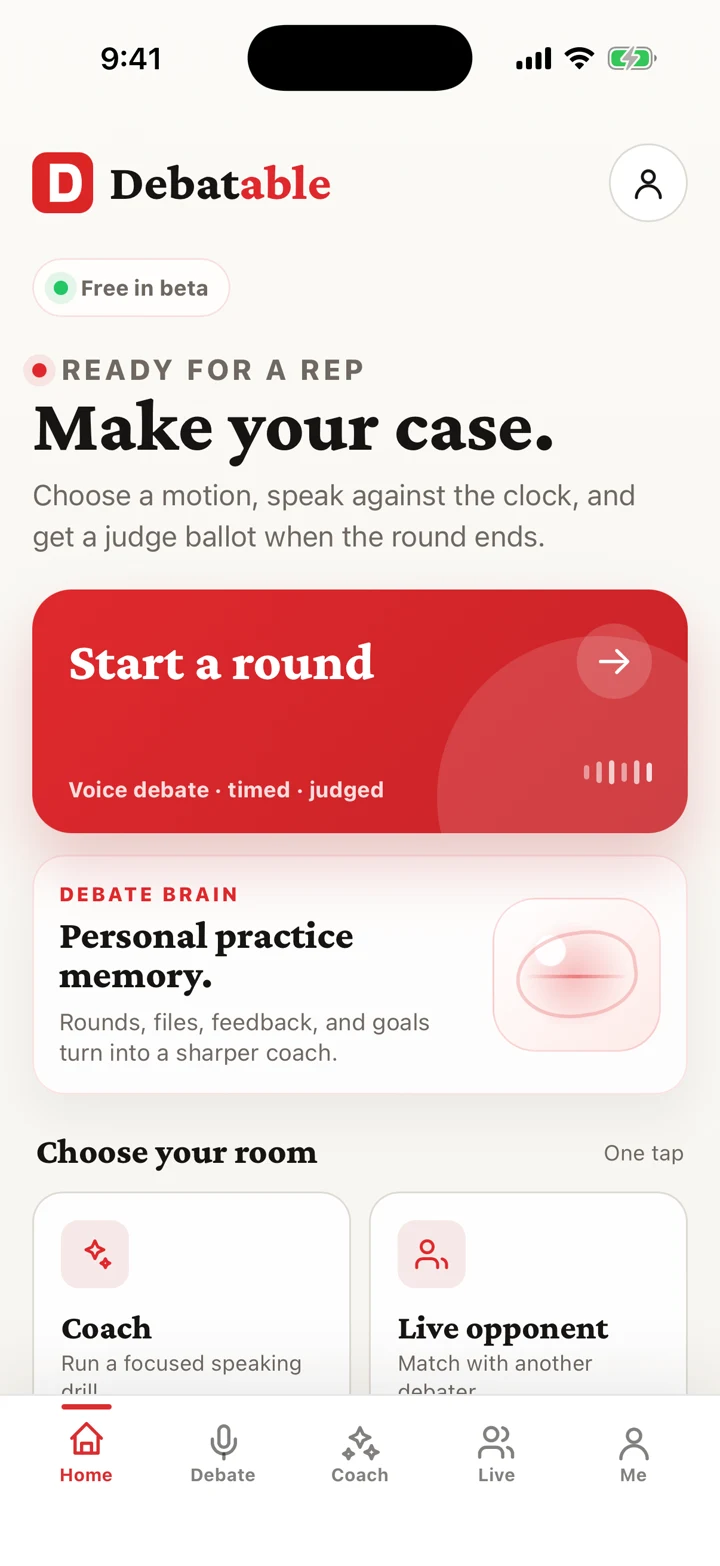
Everything on the site, on your phone. Start a timed voice round on the walk to class, match with a live opponent, and read the judge's decision before you sit down.
A machine can write your essay. It cannot defend it for you.
Written work is easy to generate now, so schools and employers are moving back to live tests: interviews, oral defenses, questions you cannot paste. Speaking under pressure is the skill that still proves you understand something. This is a place to practice it.
Everything is debatable. Come argue.